
Here on Earth, the very idea of a laser is relatively novel, having only been invented in 1958. The underlying physics is straightforward:
- an electron within a molecule gets excited to a higher-energy state,
- the electron de-transitions back to the lower energy state,
- where it emits light of a very specific wavelength in the process.
Then, pumped or injected energy re-excites an electron within that very same molecule back into that higher-energy state, over and over. This causes light of precisely that same, monochromatic wavelength to get emitted over and over again. So long as you continue stimulating the same transition, you’ll keep getting light of that exact same frequency over and over again, every time.
But out there in the Universe, this exact phenomenon occurs naturally in a number of galaxies at much longer wavelengths than the eye can see: in the microwave portion of the spectrum. Astrophysically, these objects are known as masers, and arise when energy gets injected into large populations of molecules that are only allowed to de-excite in specific ways. Using the MeerKAT array, scientists in 2022 identified the strongest, most distant maser ever seen: an object so strong that it emits more power, just in that one emission line we can observe, than the total sum of all the light emitted from 6000 Suns. Then, just a couple of weeks ago, a new hydroxyl megamaser was discovered at an even greater distance: 11 billion light-years away. This record-breaking megamaser really is a laser from space, with a story that’s billions of years in the making.
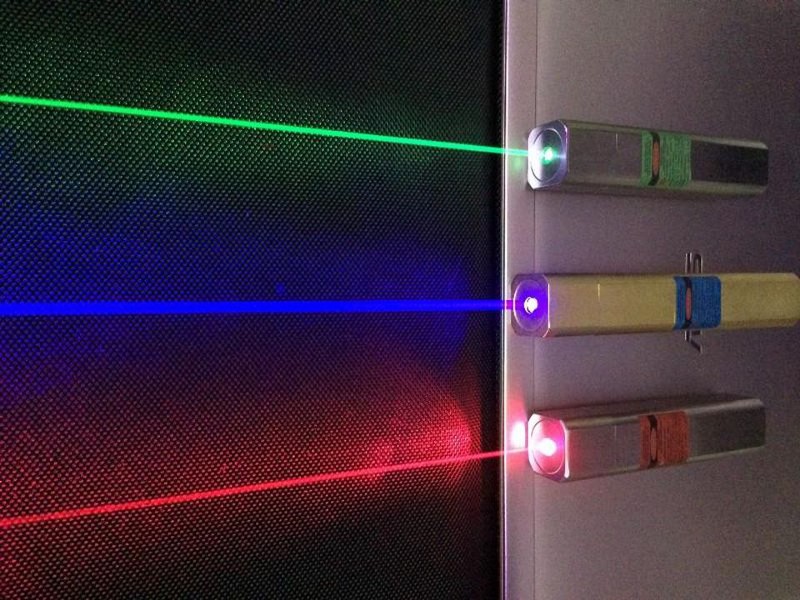
In our terrestrial laboratories, the way a laser works is both straightforward and remarkably informative, with applications that not only apply to the technologies that it enables, but to the larger Universe as well. Originally, laser was an acronym for Light Amplification by Stimulated Emission of Radiation, and the way it works is as follows.
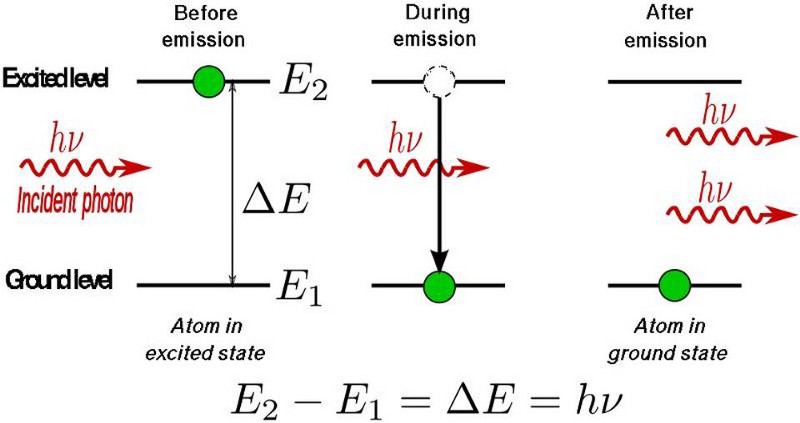
- You start with a system, like an atom, a molecule, or a crystal, that has multiple allowable energy states.
- The electron moves (or is coaxed) into an excited state, one that has the potential to transition to the same lower-energy state every time.
- You then stimulate that excited state with a photon of the desired wavelength, causing the excited state to de-excite and emit yet another photon of the desired wavelength.
- And then you pump energy back into the system, causing the de-excited component to enter back into the excited state.
It’s these oscillations of the electrons — from the lower energy state to the higher one and back down again — where the last step causes the emission of a photon of a very specific wavelength, that leads to the coherent, monochromatic light that’s characteristic of a laser. Ironically, nothing is being amplified; rather, we’ve adopted the modern term laser because of the distaste that would come along with the acronym Light Oscillation by Stimulated Emission of Radiation.
In laboratory experiments, one of the “holy grails” of laser physics is to get to the highest possible intensity of light, where intensity is energy per unit time per unit area. If you want a more intense laser, you have a few options to pursue. You can either:
- increase the total amount of energy in your laser,
- decrease the amount of time over which the energy in a laser “pulse” is emitted,
- or collimate your laser more pristinely, so that the beam intercepts a smaller area.
Laser light can either be continuously emitted or “saved up” and emitted in a single burst. The latter option has a number of important applications in physics, engineering, and technology. In fact, the fundamental technique used to achieve high-powered, short-period pulses without destroying the amplifying material was worth a share of the 2018 Nobel Prize. By creating relatively standard high-powered laser pulses, stretching them in time, amplifying the lower-power but time-stretched pulses, and then time-compressing the pulses again, an ultra-short, high-intensity laser pulse was created for the first time. Four years later, that technology was applied to achieve the vaunted breakeven point in fusion energy research at the National Ignition Facility.
The Nobel-winning research that led to that advance was a 1985 breakthrough, by Gérard Mourou and Donna Strickland, with the development of a technique known as chirped-pulse amplification. Since the arrival of that technique, laser power has increased by a factor of billions.

In space, nature is incapable of exerting the type of control over a physical system to produce monochromatic, high-powered light like we routinely do on Earth. What does occur in those natural environments, however, is fascinating in its own right. All throughout the Universe, ever since the first generations of stars lived-and-died, the cosmos has not only been populated with hydrogen and helium, but all sorts of atoms. Oxygen, carbon, neon, iron, nitrogen, silicon, magnesium, and sulfur, for example, are the third-through-tenth most common elements in the Universe today.
This means that molecular bound states involving these atoms, particularly if they’re simple bound states, should be found in many locations naturally, including in the interstellar space separating the stars within a galaxy. Some of these bound states lend themselves to the stimulated emission of radiation, even in astrophysical environments, including:
- hydroxyl (OH),
- methylidyne (CH),
- formaldehyde (CH2O),
- water (H2O),
- ammonia (NH3),
- methanol (CH3OH),
- silicon monoxide (SiO),
- silicon monosulfide (SiS),
- hydrogen cyanide (HCN),
- and carbon monosulfide (CS).
All of these molecules, under the right physical circumstances, have been observed to emit stimulated emission in space.
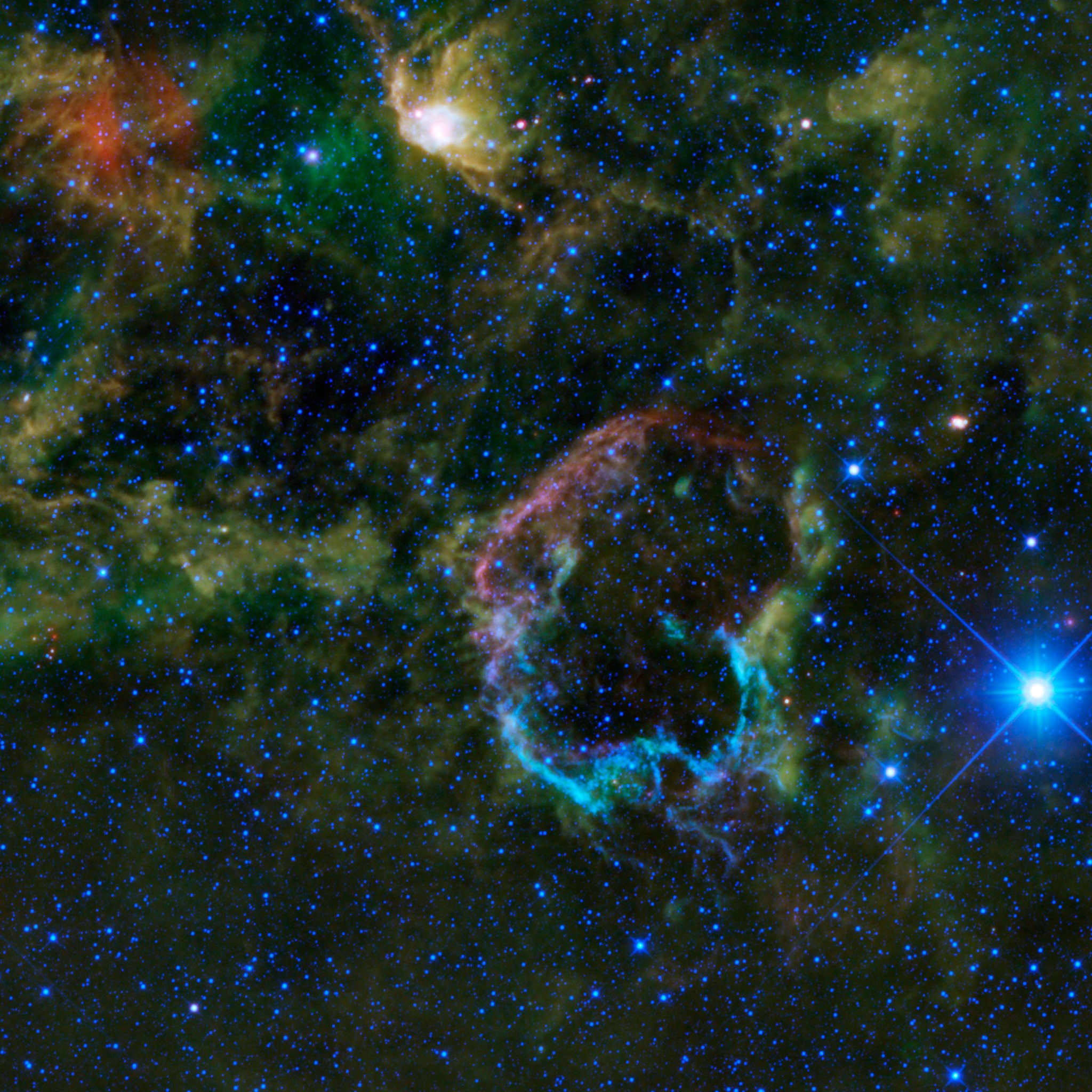
Unlike in terrestrial laboratory experiments, where masers have been created since 1953 (predating lasers by years, with the latter being known as “optical masers” before the “laser” acronym caught on), there is no possibility of a resonant or oscillatory cavity in space. All you can hope for, at best, is an energy source injected into some sort of “gain medium,” which is effectively just a pile of gas in space that gets excited to a higher-energy quantum mechanical level. When the molecules de-excite, monochromatic, microwave light is produced, resulting in what we might call a “single-pass laser,” as opposed to the more common laboratory-based oscillator-driven laser.
With oxygen being the third most common element (and hydrogen being the first) in the Universe, it’s no surprise that hydroxyl (OH) masers were the first ones discovered, followed by water, methanol, and silicon monoxide. Astrophysical masers require that these molecules exhibit a significant amount of velocity coherence, meaning that they’re all moving with roughly the same speed, otherwise we would observe radiative couplings between different parts of the gain medium.
The radiation produced by astrophysical masers is generally unpolarized, unlike laboratory-based laser light, with the only exception coming when the gain medium possesses a substantial magnetic field. And the radiation from masers is generally quite weak, as the surrounding unpumped molecules are often capable of absorbing practically all of the emitted maser light from the gain medium.
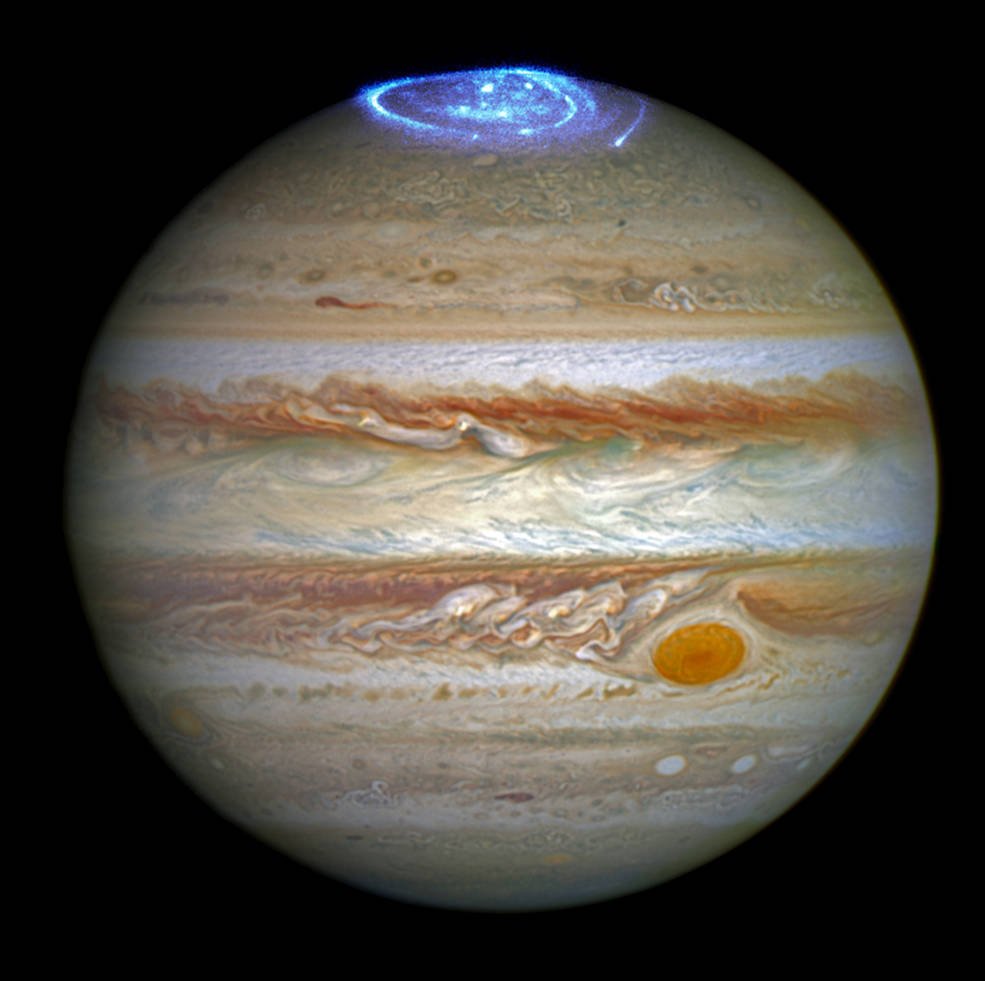
Based on all of this, you might think that you would need a highly specialized environment for a maser to exist and be detectable, but that turns out not to be the case at all. Masers have been detected:
- in the environments of comets, where vaporized volatile molecules create them,
- in the atmospheres of planets, such as when aurorae generate cyclotron masers,
- on the moons of the outer planets, where water masers have been detected in the plumes associated with Hyperion, Titan, Enceladus, and Atlas (although their presence here is disputed),
- in the atmospheres of highly evolved stars,
- in supernova remnants that interact with molecular clouds,
- and in star-forming regions, where young stellar objects and compact regions of ionized hydrogen gas produce the majority of astrophysical masers, including some of the rarest ones.
If you know something about star-forming regions, you might realize that the Milky Way itself isn’t remarkably rich in star-formation, but there are other galaxies that are. Therefore, you might think that a galaxy rich in ionized gas, like a merging galaxy, a starburst galaxy, or a galaxy with an actively feeding central black hole might be an excellent candidate for producing a maser of far greater power than we’d ever see within our own galaxy.

As it turns out, these objects do exist, and produce enormous amounts of energy in comparison to the normal classes of masers that we see; they are known as megamasers. The first two types of megamaser ever discovered are also the most common ones:
- water (in 1979)
- and hydroxyl (in 1982).
The first hydroxyl megamaser system ever seen, interestingly enough, occurred in the peculiar galaxy Arp 220 (below). At 250 million light-years away, Arp 220 is remarkable in its own right: it’s the closest ultraluminous infrared galaxy in the known Universe. Ultraluminous infrared galaxies are bright, having more than one trillion times the luminosity of our Sun. They’re named “infrared” because they emit more energy in the infrared than in all other wavelengths combined, with the overwhelming majority of their brightness caused by the stars forming within these galaxies.
Arp 220 itself is the result of two precursor galaxies that collided just a few hundred million years ago, which now find themselves in the process of merging. A massive, recent burst of star-formation has occurred all throughout the galaxy: evidence of a starburst event. Hubble has imaged the central core of this galaxy, revealing hundreds of massive young star clusters, with the most massive containing around ten million solar masses worth of material: about 250 times more massive than the largest star-forming region in our Local Group. Arp 220 also contains two bright masers, with one being a hydroxyl maser and the other being a water maser, and an enormous amount of neutral gas: billions of solar masses worth.
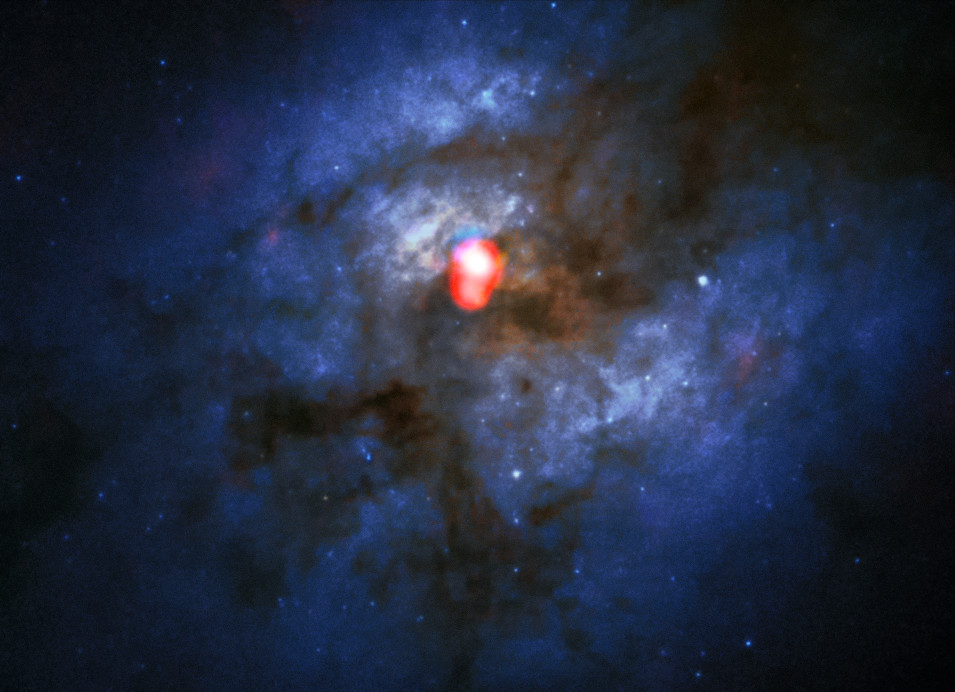
As it turns out, every hydroxyl megamaser that’s ever been discovered also is found within a luminous infrared galaxy, with the only differences between them being the size, mass, and brightness of both the galaxy and the megamaser. Typically, what’s thought to occur in these megamasers is a little bit different than in conventional masers, as the young starlight in these objects gets absorbed and re-emitted by the surrounding interstellar dust. (This is similar to how Earth absorbs sunlight of all wavelengths, but re-emits radiation in infrared wavelengths alone.) That re-emitted infrared light can then excite the hydroxyl molecules, which leads to the resulting megamaser emission.
Typically, hydroxyl masers within the Milky Way emit about 0.001% of the light of the Sun at those specific microwave maser frequencies. When Arp 220 was discovered, it was termed a “megamaser” because it’s approximately 100 million times as luminous as a typical maser. Today, there are over 100 known hydroxyl megamasers, and they all:
- are very rich in gas,
- have experienced recent galaxy mergers,
- have high molecular densities and high star-formation rates in their centers,
- and have copious amounts of dust that gets heated, causing a very high luminosity in the far-infrared part of the spectrum.
Up until this year, the farthest hydroxyl megamaser was discovered by Arecibo, at a distance of 3.7 billion light-years away.
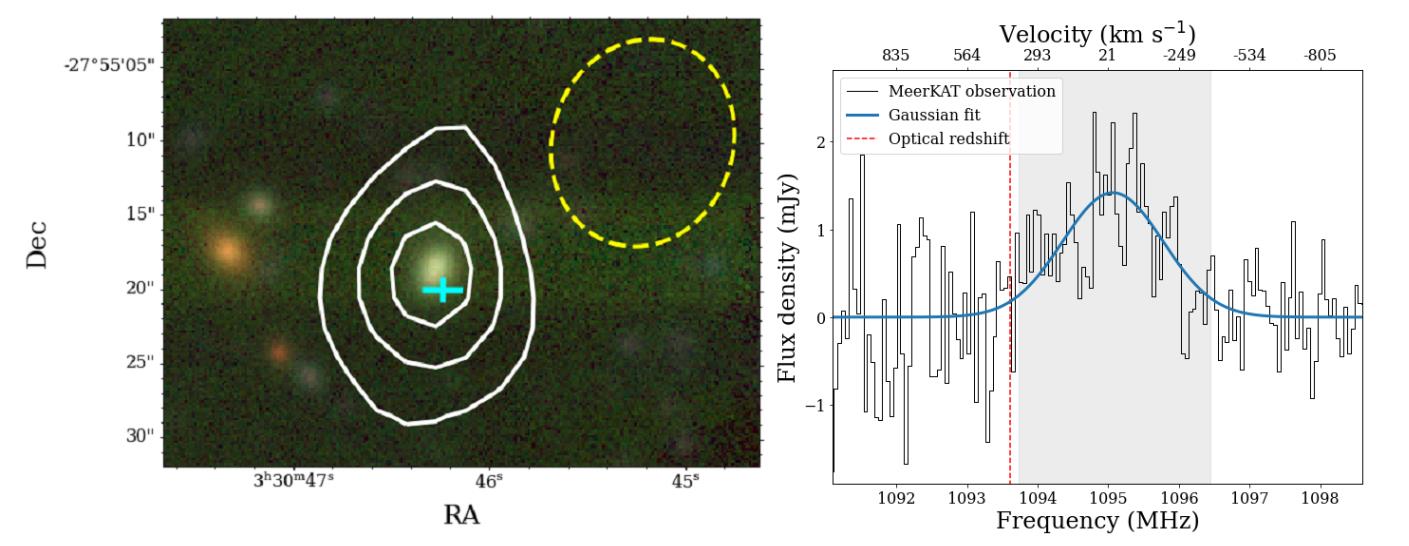
That record was shattered a few years ago, on April 6, 2022, when the preprint of a paper by the Looking At the Distant Universe with the MeerKAT Array (LADUMA) collaboration appeared. Eventually slated to be part of the Square Kilometer Array, a series of radio telescopes which will form the world’s largest network, the MeerKAT array contains 64 independent antennas that all function together. The LADUMA collaboration targeted a single patch of sky which encompasses the entire extended Chandra Deep Field South, targeting neutral hydrogen emission lines and serving as a complement to Chandra’s X-ray views, NASA’s WISE mission’s data, and the European Southern Observatory’s VISTA observations of the same region.
What they found, coincident with a galaxy at precisely a redshift of 0.5225, was a megamaser: the most distant and one of the most powerful ever seen. The astronomers named it Nkalakatha: after the Zulu word for “big boss”. The megamaser displayed an unambiguous emission line (above) that corresponds to the main hydroxyl emission line, normally seen at 1667 megahertz, redshifted to an observed frequency of 1095 megahertz. That’s exactly what you’d expect if you divided 1667 by (1 + 0.5225): a smoking gun for a (hydroxyl) megamaser signature. Exactly as expected, this galaxy did indeed turn out to be an ultra-luminous infrared galaxy at a distance of 6.6 billion light-years away, with a megamaser luminosity that’s 6300 times as great as the Sun’s total luminosity. Far and away, it’s the most distant megamaser ever seen, being almost twice as far away as the previous record-holder.
In fact, of all the megamasers ever discovered, this one was one of the most luminous both in terms of the brightness of the host galaxy and of the megamaser itself. At the time, it was the most distant laser ever seen in the Universe.

But that record, which stood for nearly four years, was just broken once again! On February 13, 2026, a new preprint of an accepted paper was published that announced the discovery of HATLAS J142935.3-002836: a megamaser located a whopping 11 billion light-years away, at a redshift of z = 1.027, and from a time when the Universe was 8 billion years younger than it is today. It’s the new most distant natural laser ever discovered, and it confirms many of the expectations that arose in the aftermath of the earlier 2022 discovery. We’ve learned that:
- these megamasers really are out there ubiquitously,
- they can be found at higher redshifts and greater distances than they had ever been detected at previously,
- that MeerKAT is capable of finding and discovering them, and breaking many cosmic records,
- and that we can fully expect the number of known hydroxyl megamasers to continue to increase.
When the full Square Kilometer Array is finally completed, commissioned, and fully functional, we can then set a new expectation: that the distance record for farthest megamaser will be broken numerous times, again and again, in the coming years.
We can now be certain that there are megamasers out there at greater distances than we’ve ever seen before, which motivates us to search farther and deeper, and to continue building next-generation observatories to enable us to find what’s out there. We’re only just learning how galaxies grow and evolve in the Universe, and by adding megamasers into that equation, we’re poised to put together yet another vital piece of the cosmic puzzle.
This article was originally published in April of 2022. It was updated in February of 2026.
This article Record-breaking natural laser discovered 11 billion light-years away is featured on Big Think.